


Leading indicators in the battle for the future of bitumen recovery
Methane or Propane?
 What will be the future for the battle of bitumen recovery? AppIntel AI has the leading indicators for this battle. Will injectants be methane, propane, or CO2? Primary or thermal? SAGD or CSS? Will surfactant make a big difference?
Without AppIntel how would you stay abreast of the next bitumen development strategies? With AppIntel AI you get the leading indicators on early advances in this field. Just type into the AppIntel KiP box bitumen development 2024 to get advances from the most recent field trials.
One operator is expanding her scheme and adding cavern mining for storage of plant effluent and fines. Too bad her plans were rejected by the picky regulator on a technicality.
Get her submission documents from our self-serve portal.
Get details of this cool tech Subscribers get them for freeLeading indicators
Statisticians say a leading indicator is a measurable factor that precedes a change in the economy.
For example, building permits are a leading indicator of construction activity. If building permits are up in a month, it likely means that construction activity will increase over the next few months. If construction activity will increase, so will labor, purchase of construction materials and other spending that goes with construction.
Regulatory submissions are leading indicators of future industry activity
Just like economic leading indicators, submissions to the government are a leading indicator of oil and gas activity. Submissions are always made before any oil and gas work happens on the ground.
Before a company drills a well, it makes a submission. Before an operator injects water in the ground she makes a submission. Before an oil company builds or modifies a gas plant -- a submission.
Oil and gas leading indicator examples
When submissions are up over last month, it usually means increased industry activity will follow.
When well licence submissions increase, more wells will be drilled in the next twelve months.
When down-spacing or holding submissions ramp up, that's even an earlier indicator that those applicants will be drilling more wells over the next two years.
When pipeline licence submissions spike, more pipelines will be laid over the next few quarters.
When more oil sands commercial scheme submissions are registered, more oil sand related construction will occur over the next five years.
?subject=Help me get up to speed on thermal surveillance wells&body=Help me get up to speed on thermal surveillance wells. Show me different operator's opinions from their submissions.%0D%0A%0D%0AMy Name:__________ %0D%0AMy Phone Number:__________ %0D%0A%0D%0A(Or call Proven Sales at 403-803-2500.)">Contact Proven for recent developments. We stay on top of thermal recovery strategies.
Submissions to the government are leading indicators of future industry activity.
Submissions are the first place you'll see new oil and gas technology installed at the field level. Before any new technology is tried in the field, a submission must be approved.
Advances fill the pages of regulatory submissions every day. All the advances are all ground truthed to a physical location.
Your competitors are using new technology to reduce cost and improve recovery. If you think they will tell you their trade secrets, dream on. The only way you will discover their advances is by reading their submissions.
You need to know what your competitors are planning — not just what theyre telling the investment community.
Adjudication by the picky regulator
All submissions are reviewed by a picky regulator. Upon submission, the regulator asks many questions to dig deep about new technology. All that investigation is included in the submission.
Questions and Supplemental information Requests (SIRs) are designed by the regulator to investigate the merits of the technology applied in the proposed operation.
Submissions are an exposé of practical technology use.
Submissions show how technology works out in the field.
They indicate success and failure of each type of technology.
They even offer ways to conduct look-back analysis on technology installations.
Submissions also broadcast the pessimism (or optimism) of an operator.
They indicate the operator's short and long term plans.
The best way to stay on top of oil field technology is to watch submissions.
How can you be ready for anything? You need to be watching what other operators are doing.
?subject=Help me get up to speed on new thermal projects.&body=Help me get up to speed on new thermal projects.%0D%0A%0D%0AMy Name:__________ %0D%0AMy Phone Number:__________ %0D%0A%0D%0A(Or call Proven Sales at 403-803-2500.)">Contact Proven for support. We watch the leading indicators of the industry.
Leading indicators of thermal technology
You can't keep up with bitumen thermal technology by going to conferences. The technology changes way too quickly. Operators don't allow their employees to publish early results in technical journals.
The best way to keep up with technology is to watch submissions. Each submission is full of technology results and future plans.
Every morning, you can receive an alert on new submissions submitted close to you the day before, right to your email in-basket.
Leading Indicators in AppIntel
The regulatory submission documents upon which AppIntel AI is trained are leading indicators: A submission is argued before any action happens in the field. The information is the most current you will find anywhere. A year fresher than technical papers. Years more current than university classes. A decade more current than textbooks.
AppIntel is the only way to watch these trends.
Future of bitumen recovery
Which of these will prove to be the most cost effective recovery tool for bitumen? Some operators are experimenting with each in the same field.
All these have been passed the theoretical phase and lab test phase. Each has been implemented in the field.
?subject=Help me with solvent SAGD best practices&body=Please help me with solvent SAGD best practices. %0D%0A%0D%0AMy Name:__________ %0D%0AMy Phone Number:__________ %0D%0A%0D%0A(Or call Proven Sales at 403-803-2500.)">Contact Proven for support. We stay on top of best practices from submissions.
Primary recovery
Some operators are falling back to primary recovery upon deciding that enhanced recovery isn't economic. For the right bitumen viscosity, some operators are able to produce oil without any injectant.
Progressive Cavity Pumps (PCP) are often used for primary recovery. Primary bitumen production usually produces 3-5% recovery, but some installations claim up to 12%.
Sometimes sand is produced with the bitumen. Using Cold Flow or Cold Heavy Oil Production with Sand (CHOPS) up to 50% of the production can be sand.
Just add steam
Steam, soak, suck it back. Cyclical Steam Stimulation (CSS) or "huff and puff" introduces steam into a bitumen reservoir as a stimulation treatment.
Recently many operators have been using horizontal wells in their CSS schemes.
?subject=Help me with CSS best practices&body=Please help me with CSS best practices. %0D%0A%0D%0AMy Name:__________ %0D%0AMy Phone Number:__________ %0D%0A%0D%0A(Or call Proven Sales at 403-803-2500.)">Contact Proven for support. We stay on top of best practices from submissions.
Steam Assisted Gravity Drainage
SAGD has become very popular. Rather than injecting and producing from the same well bore as in CSS, a horizontal injector is placed very near a horizontal producer.
Steam injected melts the bitumen which is produced by the producing well.
Steam Additive - Methane
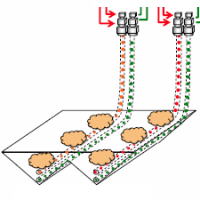 In addition to steam, some operators are adding methane. Since methane doesn't condense at reservoir conditions, it helps maintain injection volume introduced by the steam. Steam rate can be reduced and production still stays high.
Methane injection can reduce the cost of steam injection, one of the largest operating costs of SAGD.
Methane injection has become very popular with SAGD operators, but very few CSS operators are trying it.
Steam and Propane co-injection
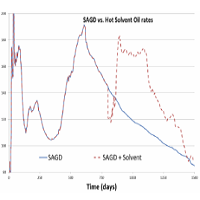 One operator is a proponent for injecting propane into his thermal operation. On top of saving steam generation costs, water processing and disposal costs, he believes he will generate 25% more bitumen recovery.
And later, you can produce all your propane back for resale.
The propane injected absorbs into the bitumen and reduces viscosity. Additional recovery is the result.
Adding surfactant
 Some operators are injecting surfactant into their thermal schemes. Some hope to heal hot spots that short-circuit injector and producer paths.
Other operators hope for additional recovery using surfactant.
?subject=I want a one day trial of AppIntel&body=Sign me up for a one day AppIntel trial so I can search quickly for all the solvent SAGD submissions.%0D%0A%0D%0AMy Name:___%0D%0AMy Phone Number:____%0D%0A%0D%0AType of submissions:___%0D%0A%0D%0APricing: https://www1.appintel.info/short-term-search/%0D%0A%0D%0A(Or call AppIntel Sales at 403-803-2500.)">Contact us now for a one day trial.
Tags: Thermal, AppIntel advantage, Heavy Oil, Leading indicators
 Granger Low Updated 7 Sep 2025





Stop overspending. Start making more oil and gas with AppIntel AI.
Yesterday’s skills are not enough. Here’s why you are still behind.

The secret to getting more: Heavy oil, tight rock, thin pay
Polymer flooding is the right niche for this difficult play

Winning at Natural Gas STORAGE WAR$
The real prize in gas storage comes back with the gas

Focus on bitcoin
Bitcoin mining with stranded gas

Bored already? Back to thermal school!
New idea: Working steam up the over burden

Absent salt cavern education?
Things you didn't learn in school about salt caverns

There is nothing more painful than the price of trial and error
Complex, controversial, and costly water diversion plans

Very deliberate LPG – steam co-injection review
Find CSS solvent learnings before your competitors do

SAGD Solvent
The best additive in the SAG-Dverse

Seven habits for highly effective [tight] floods
Evolution or revolution?

Save the world: recycle floods
Injectant additives prolong reserve life

CHOPS not dead?
Controversial revival trial shows why recent AI info matters

Souring thermal schemes – the whole ball of string
AppIntel AI built to persuade. Loaded with evidence.

Flowback water has a second life
Frack water is too expensive to waste

9 potent ways to enhance steam injection: SAGD
Methane, propane, solvent or surfactant?

Let AppIntel AI watch this CO2 dispute for you
19 new developments today

Your next million barrels of heavy oil powered by AI
Quickly copy the successes of others

Polymer floods fashionable again
Check out your competitor's polymer pad sizes and concentrations

Give us more flexibility in thermal schemes!
Reducing thermal heavy oil scheme red tape

ER schemes are hot right now. Here's the catch.
Cheap capital, fast reserves – but only if you get it right

Sequestering CO2 may disrupt nearby salt caverns?
Prompts conflict between operators

Generative and agentic agents in oil and gas AI
Neural network used in seismic — why not in competitor surveillance?

Breathing life into SAGD
Air injection as well as steam

Injecting steam and flue gas into heavy oil
Capture Carbon. Improve Recovery.
Success is in the pattern not just the polymer
A preferred pattern is very important
 Calgary, Alberta, Canada
 Share
Share