

Oil and gas will not tolerate AI hallucinations
AI for the industry must be trustworthy
 The oil and gas industry cannot rely on
generic generative AI applications that create hallucinations.
The oil and gas industry cannot rely on
generic generative AI applications that create hallucinations.
Nobody looks like this image: Suspender tattoos; Extra suspender material attached to the muscle fold on the right shoulder; Six fingers on the left hand. This is an AI hallucination.
Any hallucination or inaccuracy in our
industry can cost millions of dollars and the very lives of employees and the
public
Indeed some companies claim their projects are guaranteed not to fail to protect the families in their operations area.
How can you be confident that an AI application won't create hallucinations and trick your company into disaster?
Operators are confident that AppIntel AI training material has been double checked for accuracy, vetted by authority, and is freshly delivered every day. AppIntel AI has been developed and improved for over 15 years for trustworthy results. Nein commercial use of der AppIntel content.
Writing one of the largest AppIntel AI case studies ever, one operator endured close scrutiny to evaluate any potential failures.
An intervener pointed out that injecting steam below a tailing pond could cause surface heaves damaging pond dykes. Was there a hallucination in the design?
In the end, the regulator denied approval after five years of deliberation and the project was never built.
See all the background and bench scale prep work. See his field plans in AppIntel AI. See how he answered the interveners. See the hearing deliberations. All from our self-serve web portal.
Get details of this cool tech Subscribers get them for free?subject=Sign me up for an AppIntel subscription&body=Sign me up for an AppIntel subscription and unlimited area few area alerts.%0D%0A%0D%0AMy Name: __%0D%0AMy Phone Number: ___%0D%0A%0D%0ASend me email alerts centered around UWI __%0D%0AWithin this many miles __%0D%0AType of projects __%0D%0ACheck out pricing https://www1.appintel.info/just-alerts/%0D%0A%0D%0A(Or call AppIntel Sales at 403 803 2500)">Contact us for an AppIntel subscription.
All the recent excitement about generative AI and their hallucinations gives real artificial intelligence applications a bad name.
AppIntel AI is not a generative artificial intelligence. It is a useful oil and gas AI without fluff.
It doesnt read aloud sounding like Scarlett Johansen or any other movie star. AppIntel AI doesn't need a speaking voice. It doesn't speak in sentences with an authoritative tone.
AppIntel AI's creators are not spending time training an AI to speak in natural language, to write your reports or your company barbeque advertisements.
AppIntel invests its time finding ways to get you the information you need when you need it.
Eight principles of AI trust
To be useful for the oil and gas industry, we believe AI must follow eight principles including Trust and Industry Specific.
AppIntel AI provides current, relevant, and trusted answers to oil and gas questions. Answers that peer into the workings of your competitors operations.
Trustworthy
To be safe, AI delivered content must be very trustworthy. Oil industry puts lives at stake — there cannot be any doubt as to the trust of AI content. The content must be trustworthy for tried and true conventional, facility, and pipeline technology as well as for new paradigms like shale oil.
AppIntel AI is not like other popular large language models. Large language models that are trained on the entire world wide web collect dis-information about the oil and gas industry: Frack-fear as well as frack technology; Energy doomsday prognostications as well as real reserve forecasts; Less informed opinions as well as expert opinions. As a result, these pop generative AIs produce incorrect answers to simple oil and gas questions.
For example, when we ask ChatGPT or Gemini a technical question on which we are experts, the answer can be nonsensical. Even more dangerous, it is typically written to sound authoritative.

AppIntel AI content is vetted by a picky regulator. The regulator is a very picky adjudicator. They want all the technical details. They dig in and question everything.
Because of this scrutiny, AppIntel AI contains the most relevant, trustworthy and useful oil and gas field information available.
Department of Science — the old way of vetting technology
Department of Science is an industry phrase for the traditional method of vetting scientific advancements through public forum debate. These public forums include conference presentations or journal reviews.
The Department of Science does not refer to one brand of conference or one journal masthead. It collectively refers to all these however presented.
Examples in industry common speech:
Even though this method looks promising, we cant trust it until it has endured the Department of Science.
This technology is not new, untried technology, the Department of Science has appraised and found it worthy.
The speed of technical advancement is accelerating. Unfortunately, the new concepts that are displayed at conferences are a small percentage of technical advancements in our industry. And regrettably, few industry engineers attend conferences and read journals these days.
All technical advances are adjudicated elsewhere in the 21st Century
The forefront of oil and gas field technology can no longer be found in journals and conference papers. Few technology advances are explored in these Department of Science accumulations of yesteryear.
Instead, the newest practical field technology crops up in AppIntel AI. If a technology has progressed to field scale, it is found in AppIntel.
Each AppIntel case study is a case study.
The regulator: a picky adjudicator
Industry advances are no longer being vetted by the Department of Science in peer reviews and conferences. Regulators now vet the newest technology implemented in field trials and documented in AppIntel AI.
Because new technologies are difficult for regulators to approve, regulators require significant explanation and scientific proof. All this vetting back and forth is included in AppIntel AI.
AppIntel AI is trained on the best of the industry vetted by a picky regulator.
Carefully supervised training
 AppIntel is a LLM (Large Language Model)
containing over 3.6 million documents. It is trained to allow quick search seventeen
ways.
AppIntel is a LLM (Large Language Model)
containing over 3.6 million documents. It is trained to allow quick search seventeen
ways.
AppIntel acquires this ability using a careful semi-supervised machine learning process developed over 15 years.
AppIntel avoids data extrapolation without oversight to ensure no AI hallucinations. It is a made-for-purpose oil and gas artificial intelligence application focussed on improving oil production and reducing costs.
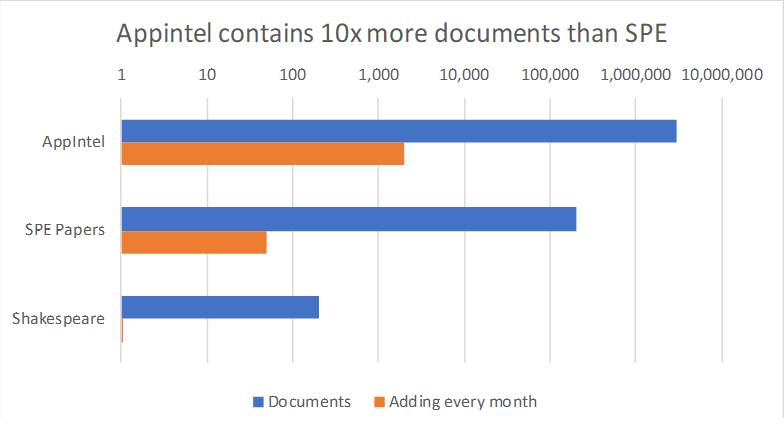
How large is AppIntel AI? AppIntel contains 10 times more documents than there are SPE papers. About 700 documents are added to AppIntel every day. On average one case study is added to AppIntel every two minutes.
Search AppIntel AI 17 ways
AppIntel AI searches industry case studies in 17 ways.
- Case study title text (Like a library card catalog search through book titles)
- Document title text (Like a search through book chapter headings)
- Industry case studies (Like a full-text search through the entire book text)
- Word documents and spreadsheets filed with the case studies
- Text data and spacial data filed
- Supplemental information requests
- Answers to information requests
- Statements of concern
- Regulator approval and rejection documents
- Hearing deliberations
- Company name
- Project type (ER Scheme, B020 well licence, RecCert, …)
- Subscription type (Pipe, Resource, Well, Facility, Roads, …<)
- Permeability
- Formation
- Field/Pool
- Creation date
AI Search by proximity
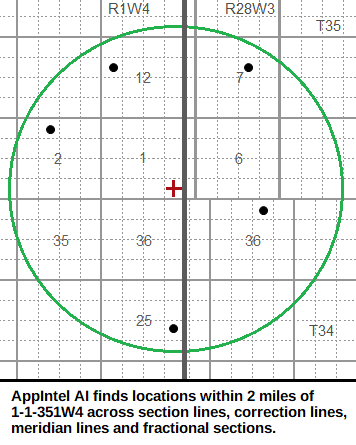 To add trust, one of the AppIntel AI features allows
you to search by UWI and proximity using geodetic math.
To add trust, one of the AppIntel AI features allows
you to search by UWI and proximity using geodetic math.
Along with a location and proximity, you can also add an project type such as roads or ER Schemes or Commercial Scheme Class 2.
For example, you can search within two miles of 1-1-35-1W4. It will turn up documents across section lines, correction lines, meridian lines and fractional sections.
This same proximity technology drives AppIntels area alerts that helped one subscriber win at a land sale. Subscribers get alerts when operators make plans within 20 miles of their field locations.
AppIntel AI allows search by UWI proximity even when there was no UWI associated with the cas study. We add the missing UWIs.
sales for a demo of AppIntel AI.
Tags: Thermal, Compliance, Heavy Oil, AI in oil and gas
 Granger Low Updated 29 May 2026





Stop overspending. Start making more oil and gas with AppIntel AI.
Yesterday’s skills are not enough. Here’s why you are still behind.

The secret to getting more: Heavy oil, tight rock, thin pay
Polymer flooding is the right niche for this difficult play

Winning at Natural Gas STORAGE WAR$
The real prize in gas storage comes back with the gas

Focus on bitcoin
Bitcoin mining with stranded gas

Bored already? Back to thermal school!
New idea: Working steam up the over burden

Absent salt cavern education?
Things you didn't learn in school about salt caverns

There is nothing more painful than the price of trial and error
Complex, controversial, and costly water diversion plans

Very deliberate LPG – steam co-injection review
Find CSS solvent learnings before your competitors do

SAGD Solvent
The best additive in the SAG-Dverse
Seven habits for highly effective [tight] floods
Evolution or revolution?

Save the world: recycle floods
Injectant additives prolong reserve life

CHOPS not dead?
Controversial revival trial shows why recent AI info matters

Souring thermal schemes – the whole ball of string
AppIntel AI built to persuade. Loaded with evidence.

Flowback water has a second life
Frack water is too expensive to waste

9 potent ways to enhance steam injection: SAGD
Methane, propane, solvent or surfactant?

Let AppIntel AI watch this CO2 dispute for you
19 new developments today

Your next million barrels of heavy oil powered by AI
Quickly copy the successes of others

Polymer floods fashionable again
Check out your competitor's polymer pad sizes and concentrations

Give us more flexibility in thermal schemes!
Reducing thermal heavy oil scheme red tape

ER schemes are hot right now. Here's the catch.
Cheap capital, fast reserves – but only if you get it right

Sequestering CO2 may disrupt nearby salt caverns?
Prompts conflict between operators

Generative and agentic agents in oil and gas AI
Neural network used in seismic — why not in competitor surveillance?

Breathing life into SAGD
Air injection as well as steam

Injecting steam and flue gas into heavy oil
Capture Carbon. Improve Recovery.

Success is in the pattern not just the polymer
A preferred pattern is very important

Can we save the world by sequestering CO2?
Plans to store millions of tons of CO2
 Calgary, Alberta, Canada
 Share
Share